- Positioning and audience analysis in spring 2026
- New architecture: one entry point per audience, a clear pipeline page
- Scientific writing of the key pages, validated by the team
- Visual update in continuity with the existing brand guidelines
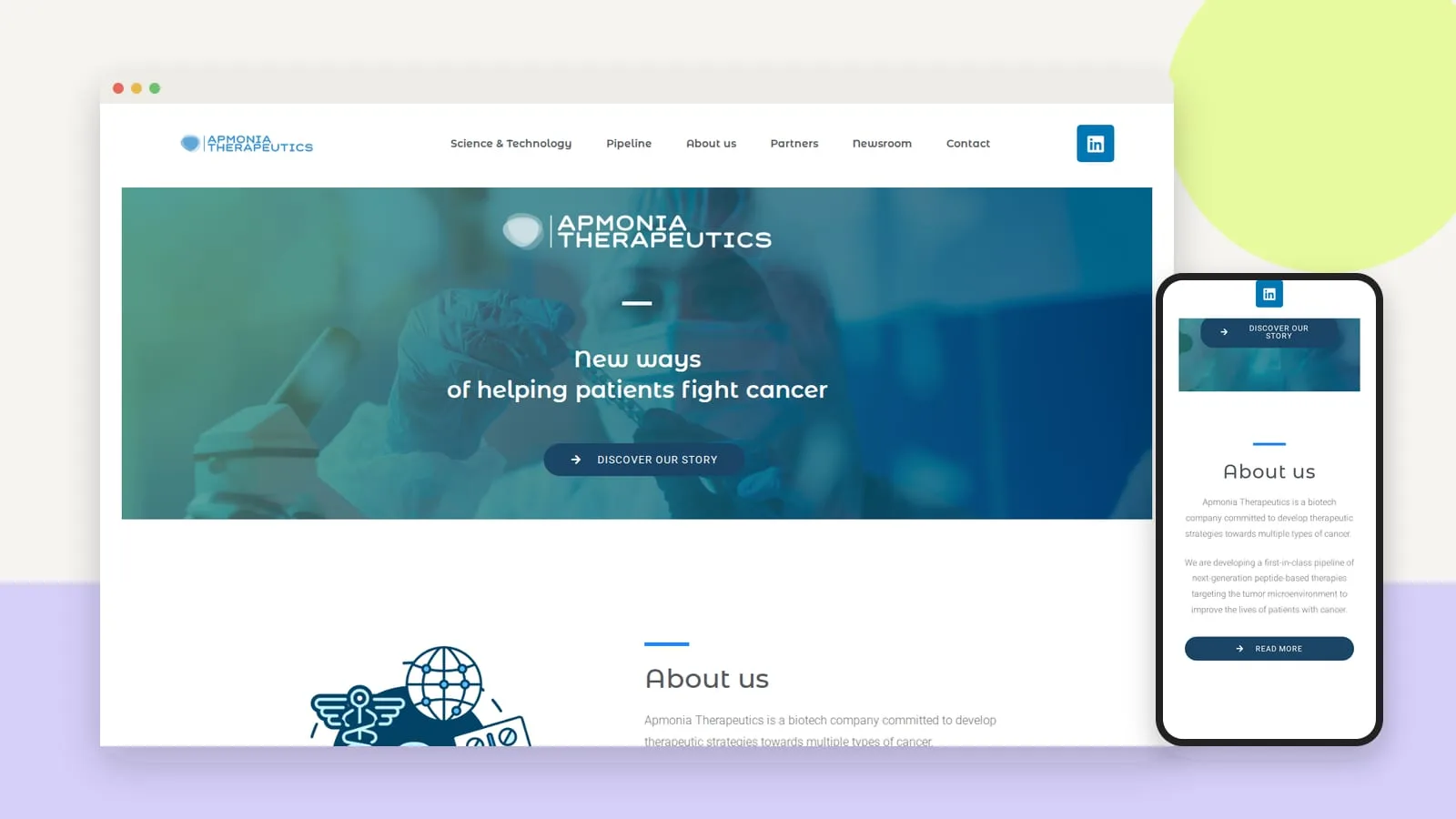
Apmonia Therapeutics develops next-generation peptide therapies targeting the tumour microenvironment. Its lead programme is entering a phase 1/2a clinical trial. At this stage, the website must say clearly where the company stands: DigiObs reworked its positioning, its architecture and its content.
The context
A biotech moving from preclinical to clinical stage changes audience. Investigators, industrial partners and future colleagues all visit the same website, and each looks for a different proof: the strength of the mechanism of action, the reality of the regulatory milestones, the team's ability to keep to the timeline.
The Apmonia Therapeutics website dated from the preclinical period. It described the science, not the step taken.
The mission
Bring the website up to the stage the company has reached, for each of its audiences.
- Positioning analysis: what sets Apmonia's approach apart, and how to say it to each audience
- Website architecture: what each audience must find, and in what order
- Scientific writing of the key pages, with the team's validation at each step
- Visual and editorial update, in continuity with the company's brand materials
Is your biotech changing stage, and your website must follow?
Let us talk about your audiences, your milestones and what you can say today: we will propose the positioning and the scope of your website update.
Our approach
We started by listening: discussions with management and the scientific team set what could be said, when, and with what level of precision. In oncology, a page that promises too much is costly, and a page that explains nothing is useless. The website holds that balance: explain the mechanism of action and the scientific rationale, document milestones once they are reached, show the team.
The positioning analysis carried out in spring 2026 served as the basis of a new architecture: one entry point per audience, a pipeline page that says clearly where each programme stands, a news section that is easy to keep up to date between milestones.
The visual update builds on the existing brand guidelines rather than replacing them: the website gains clarity without losing what makes it recognisable.
What it changes
The Apmonia Therapeutics website now reflects a clinical-stage company: each audience quickly finds what it came for, and the progress of the programmes can be read at a glance.
Above all, the team has a framework: what gets published, what awaits validation, what is updated at each milestone. Management's time goes to review, not production.
Why it works
- A positioning written with the scientific team, which sets what is said and what is not
- An architecture designed by audience rather than by org chart
- A pipeline page that shows progress without overpromising
- Brand guidelines extended rather than replaced
- A DigiObs team used to the communication constraints of the life sciences