There is a dominant narrative in the startup and innovation ecosystem: the bold founder who bets everything, takes outsized risks and ends up triumphant. Move fast and break things. It makes for great TED talks. It also causes a lot of damage.
Because behind every celebrated unicorn, there are hundreds of companies that crashed, not for lack of a brilliant idea, but for failing to manage the risk inherent in innovation. The frantic race to innovate, driven by the pressure of markets, investors and media cycles, produces a dangerous illusion: that speed alone is enough.
This is where an underrated notion comes in, almost elegant in its logic: de-risking.
What is de-risking?
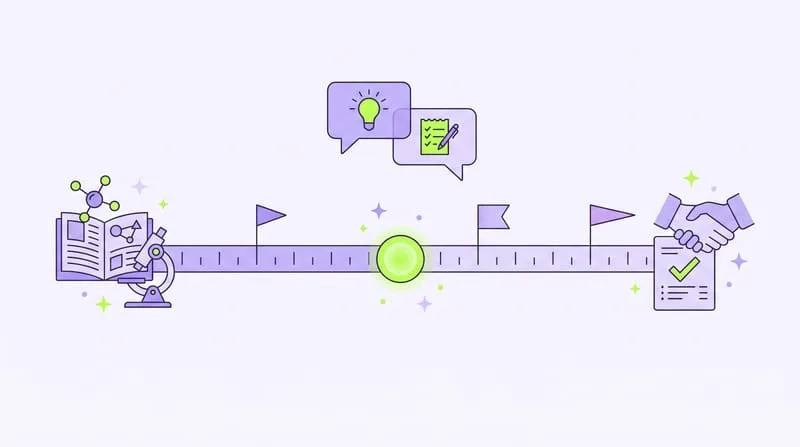
De-risking does not mean avoiding risk, which would mean giving up on innovation. It means methodically reducing uncertainty at every stage of a project, so that the residual risk is a calculated, accepted risk, not a blind bet.
The notion runs through very different worlds, but with a remarkably common logic.
In finance and entrepreneurship
An entrepreneur who puts all their cash into a single product, a single market, a single acquisition channel is not taking a risk, they are playing roulette. Financial de-risking relies on diversifying investments, staggering commitments (milestones), and progressively building market evidence before scaling. Venture capital itself is a de-risking machine: each funding round (seed, series A, series B) corresponds to a validation stage, traction, product-market fit, unit economics, that reduces uncertainty for every player.
In biotech and pharma
The pharmaceutical industry has raised de-risking to the rank of a discipline. And for good reason: developing a drug costs on average 1.3 billion dollars, and only 1 molecule in 10,000 reaches the market. In this context, de-risking is not timid caution, it is a condition of survival. It relies on predictive selection of molecules (now assisted by AI), adaptive clinical trials, diversification of the R&D portfolio, and progressive validation through proofs of concept on targeted populations.
In business strategy
More broadly, any company that innovates, whether it launches a new digital service, an offering in an unknown market, or an internal transformation, can apply a de-risking logic: test small before deploying big, validate hypotheses before turning them into heavy investments, build fast feedback loops.
Philippe Aghion and the economics of creative destruction
The thinking of Philippe Aghion, 2025 Nobel Prize in Economics for his work on innovation and growth, offers a powerful theoretical framework for understanding why de-risking matters so much.
Aghion formalized the idea that long-term growth does not come from capital accumulation but from innovation. And innovation, in his Schumpeterian theory, is inseparable from creative destruction: each technological advance replaces the previous technologies, each innovative company shakes up the incumbents.
Without technical progress, no sustainable growth, because you cannot grow indefinitely by accumulating capital, due to diminishing returns.
But here is the paradox Aghion identifies: for innovation to happen, there must be incentives, and therefore innovation rents. Yet yesterday's innovators use precisely these rents to prevent new innovations. This is the trap of unregulated innovation.
Key insight: Aghion
The solution lies not in less risk, but in better management of risk. Aghion proposes three levers: massive investment in fundamental research, an industrial policy targeted at the major challenges (health, energy, AI), and an agile regulatory framework that encourages experimentation without letting incumbents block newcomers.
In other words, de-risking at the macroeconomic level means creating the conditions for innovation to be possible, frequent and distributed, not reserved for the few players able to absorb massive failures.
De-risking applied to communication and marketing
What is fascinating is that this logic also applies to our business. At DigiObs, we support biotech, scientific and technical companies with their visibility. And we observe a recurring pattern: companies that innovate brilliantly in their core business, but take reckless risks in their communication strategy.
Launching a website without validating the key messages with the target audience. Investing heavily in paid search without building SEO foundations. Posting on LinkedIn without an editorial strategy. All bets that consume budget with no guaranteed return.
Marketing de-risking is exactly what we practice: validating the positioning before producing content, testing messages before scaling them, measuring results before scaling investments. It is the data-driven approach applied to science communication.
De-risking in communication: a discipline in its own right
People often underestimate how much communication is a field of risk. A poorly calibrated message is a burnt budget, but also a damaged brand image, a lost audience, a blurred positioning. And unlike a product that can be withdrawn from the market, published content leaves a lasting footprint, especially in search engines and now in the answers of generative AI.
De-risking your communication means applying the same rigor as biotech to what you say publicly. In practice, this involves several mechanisms:
Validating the positioning upstream. Before producing any content, you analyze the market, the competitors and the real queries of your audiences. It is the equivalent of molecular screening: you eliminate the messages that will not resonate before investing in their distribution. Too many scientific companies communicate from what they want to say, not from what their audience needs to hear.
Iterative testing of messages. Rather than betting on a single campaign, you test several angles, several formats, several channels, and you measure. A LinkedIn post that underperforms is not a failure, it is a data point. This pilot approach identifies high-impact messages before scaling them across every channel.
Building lasting assets rather than one-off hits. SEO is the perfect example of de-risking in communication: instead of depending solely on paid media (which stops when the budget stops), you build organic visibility that works over time. Every well-ranked piece of content is an asset that keeps generating traffic and leads for months, even years.
Monitoring as a safety net. Continuously watching what competitors say, what audiences search for and how algorithms evolve is the monitoring that lets you adjust the trajectory before leaving the track. In a context where generative AI is reshuffling the cards of visibility (who will be cited by ChatGPT? By Perplexity?), this monitoring becomes a first-rate strategic de-risking tool.
In short, a scientific company that de-risks its R&D but leaves its communication to chance commits a fundamental inconsistency. The methodological rigor that is the strength of science should run through every aspect of the strategy, including the way that science is told to the world.
Three de-risking principles that apply to any project
1. Sequence the commitments
Do not bet everything at once. Break the project into stages, each with its validation criteria (go/no-go). In biotech, it is phase I/II/III. In marketing, it is the A/B test, the pilot on one segment, the proof of concept before roll-out.
2. Diversify the hypotheses
Do not bet on a single scenario. In finance, it is the diversified portfolio. In pharma, it is the multi-molecule pipeline. In communication, it is the multichannel strategy, testing several angles, and permanent competitive monitoring.
3. Build fast feedback loops
The faster you learn what does not work, the less you waste. Aghion insists on an agile regulatory framework. In a company, it is monthly reporting, real-time analytics, and field feedback built into the decision loop.
Conclusion: innovating means knowing how to take smart risks
De-risking is not the enemy of boldness. It is its best ally. The companies that last are not those that take the most risks, but those that take them best.
Philippe Aghion theorized it at the scale of nations. Biotechs practice it at the scale of molecules. Entrepreneurs should apply it at the scale of their projects. And communicators, at the scale of their strategies.
The next time someone tells you “you have to be bold”, ask them: bold about what, to validate what, with what safety net? That is de-risking. And it may be the most underrated skill in the innovation ecosystem.